Quel est le taux d'humidité optimal pour les guitares ?


 288 Comments


En tant que guitaristes, nous passons d'innombrables heures à pratiquer des gammes, à perfectionner des accords et à polir la finition de nos instruments préférés. Nous achetons des cordes de première qualité, des étuis rigides et des médiators haut de gamme. Mais il existe un ennemi invisible qui se cache chez vous et qui peut détruire votre précieuse guitare acoustique sans que vous ne la fassiez jamais tomber : l'air lui-même.
Le bois est organique, poreux et très sensible à l'environnement. Il respire. Lorsque l'air ambiant change, votre guitare change avec lui. Comprendre la relation profonde entre une guitare et l'humidité n'est pas seulement une compétence d'entretien avancée, c'est le facteur le plus important pour prolonger la durée de vie de votre instrument.
Alors, quelle est l'humidité optimale pour les guitares, comment la volatilité climatique ruine-t-elle votre son, et comment pouvez-vous construire sans effort un environnement sûr pour votre collection ? Plongeons-nous dans le guide ultime des guitares acoustiques et de l'humidité.
Pourquoi l'humidité peut faire ou défaire votre guitare
Pour comprendre pourquoi une humidité appropriée est importante pour les guitares, nous devons examiner comment une guitare acoustique est construite. Les guitares acoustiques de haute qualité sont fabriquées à partir de fines pièces de bois de résonance massif (comme l'épicéa, l'acajou ou le palissandre) maintenues ensemble par de la colle spécialisée et des barres de renfort internes en bois.
Parce que le bois absorbe et libère naturellement l'humidité, il gonfle quand il est mouillé et se contracte quand il sèche.
Quand l'air est trop humide : Le bois gonfle. La table de votre guitare se courbera vers l'extérieur, l'action (la distance entre les cordes et la touche) augmentera, rendant le jeu incroyablement difficile, et votre beau son deviendra brouillé et sans vie.
Quand l'air est trop sec : Le bois se contracte. C'est bien plus dangereux. Au fur et à mesure que le bois se resserre, il crée une tension immense. La table s'enfoncera, les frettes commenceront à dépasser des côtés du manche (extrémités de frettes aiguisées), et finalement, le bois se fissurera physiquement sous la pression.
Maintenir une bonne humidité pour les guitares garantit que le bois reste dans son état calibré en usine, protégeant ainsi votre investissement et votre son caractéristique.

Quelle est l'humidité parfaite pour les guitares
Alors, quels sont les chiffres réels que vous devez viser ?
L'humidité absolue parfaite pour les guitares est une humidité relative (HR) stable de 45 % à 55 %, avec une température ambiante idéale de 21 °C à 24 °C (70 °F à 75 °F).
Bien qu'une légère fluctuation entre 40 % et 60 % soit généralement gérable pendant de courtes périodes, rester dans la fenêtre de 45 % à 55 % est la norme universelle pour une humidité idéale pour la conservation des guitares acoustiques.
Les signes avant-coureurs d'un climat dangereux
Vous n'avez pas besoin d'un diplôme en lutherie pour savoir quand votre environnement endommage votre instrument. Surveillez ces signes avant-coureurs clairs :
|
Scénario |
Symptôme sur la guitare |
Ce que cela signifie |
|
Trop sec (<40 % HR) |
Frettes qui frisent sur les cordes à vide, fils de frette coupants sur le bord du manche, fissures visibles sur la finition. |
La guitare est desséchée. Le bois se contracte rapidement. |
|
Trop humide (>60 % HR) |
Action élevée, cordes trop éloignées de la touche, chevalet se soulevant du corps, odeur de moisi à l'intérieur de la rosace. |
La guitare est gorgée d'eau. Les joints de colle se ramollissent. |
Comment créer l'humidité optimale pour les installations de pièces de guitare
Si vous possédez plusieurs instruments, les garder tous rangés dans des étuis rigides individuels avec de petits humidificateurs de rosace peut être un véritable casse-tête. Cela vous décourage de prendre votre guitare et de jouer. La meilleure solution est de désigner un espace spécifique, comme un studio, un bureau ou une salle de musique, et d'optimiser l'humidité de toute la pièce pour les guitares.
Voici comment vous pouvez contrôler pas à pas l'humidité des environnements de salles de guitare :
Étape 1 : Scellez la pièce
Les courants d'air provenant des fenêtres ouvertes, des portes ou des couloirs courants feront constamment dérailler vos efforts de contrôle climatique. Gardez la porte de votre salle de musique fermée pour isoler la masse d'air.
Étape 2 : Utilisez un humidificateur à brume froide (pour les hivers secs)
Pendant l'hiver, le chauffage artificiel élimine l'humidité de l'air, faisant chuter l'humidité à un dangereux 20 %. L'utilisation d'un humidificateur à brume froide évaporatif ou ultrasonique dédié dans votre salle de guitare réintroduira en toute sécurité l'humidité pour atteindre l'humidité correcte pour les guitares.
Étape 3 : Utilisez une climatisation ou un déshumidificateur (pour les étés humides)
Pendant les mois d'été chauds et humides, utilisez votre climatisation ou un déshumidificateur à compresseur. Les climatiseurs extraient naturellement l'humidité ambiante de l'air, vous aidant à ramener un niveau d'humidité étouffant de 75 % à un niveau sûr et confortable de 50 %.
Comment surveiller l'humidité dans une pièce de guitare
On ne peut pas gérer ce que l'on ne mesure pas avec précision. De nombreux guitaristes supposent à tort que si une pièce leur semble confortable, elle doit être sûre pour les besoins d'humidité de leur guitare acoustique. Cependant, la peau humaine est un hygromètre peu fiable. De plus, les conditions climatiques peuvent varier considérablement entre la tablette supérieure d'un placard et un support posé sur le sol.
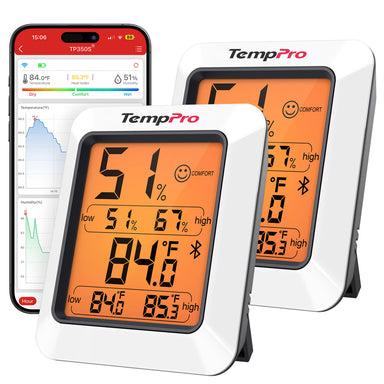
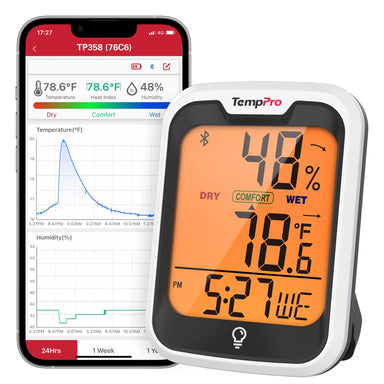
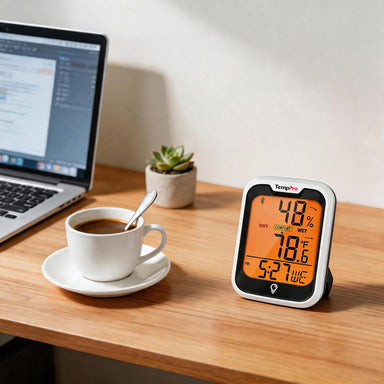
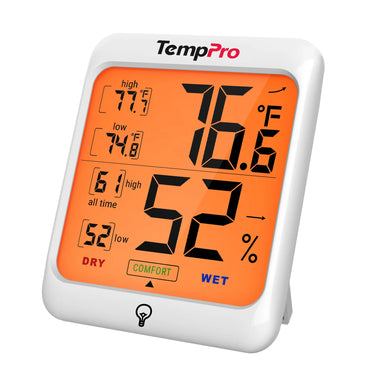
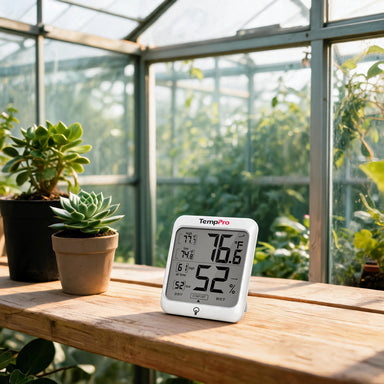
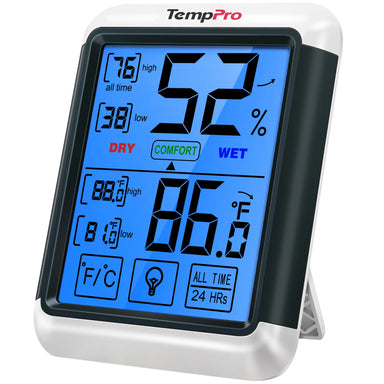
Le meilleur outil de défense qu'un guitariste puisse posséder est un instrument de précision comme le TempPro TP359 Thermomètre Hygromètre Bluetooth. Au lieu de compter sur une jauge en plastique bon marché et imprécise, le TempPro TP359 utilise des capteurs avancés de fabrication suisse pour fournir des mises à jour hyper-précises en temps réel de la température et de l'humidité relative.
Pourquoi le TempPro TP359 est un équipement indispensable pour les guitaristes :
- Surveillance à distance : Vous pouvez placer le capteur compact juste à côté de vos supports muraux de guitare ou à l'intérieur de votre rack multi-guitares, tout en plaçant l'écran clair et rétroéclairé sur votre bureau.
- Alertes instantanées sur smartphone : Grâce à la connectivité sans fil, vous pouvez suivre votre climat via votre téléphone. Si votre fournaise domestique se met en marche au milieu de la nuit et fait chuter l'humidité de la pièce en dessous de la zone de danger, l'application vous alertera immédiatement, vous permettant de sauver votre guitare avant que le bois ne se fende.
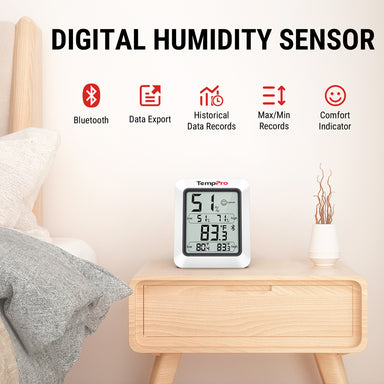
- Tendances des données historiques : Le TempPro TP359 stocke les enregistrements hauts et bas, vous permettant de voir exactement la stabilité de votre pièce sur une période de 24 heures. La constance est la clé ; les changements rapides d'humidité endommagent les guitares plus rapidement qu'un environnement stable, légèrement imparfait.
- Haute précision : Grâce à ses capteurs précis, le TempPro TP359 fournit des lectures exactes de la température et de l'humidité, afin que vous sachiez exactement ce qui se passe dans l'environnement de votre guitare.
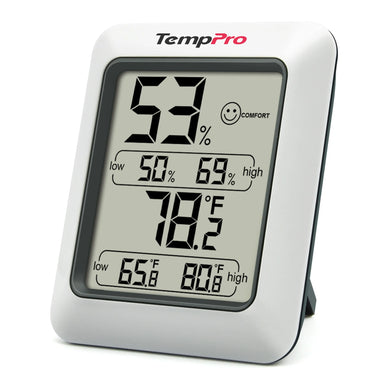
- Mémoire min/max : Il suit et affiche les lectures minimales et maximales sur une période de 24 heures. C'est incroyablement utile car l'humidité peut fluctuer considérablement entre le jour et la nuit, et vous pourriez manquer un pic ou une chute dangereuse sans cette fonction.
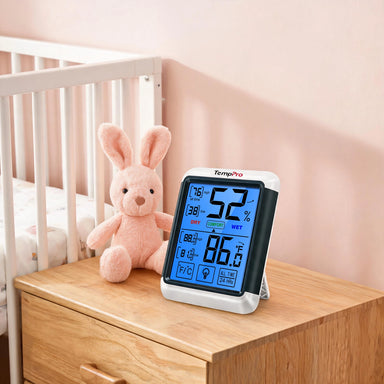
- Écran rétroéclairé : Facile à lire dans toutes les conditions d'éclairage, vous pouvez ainsi vérifier les conditions même dans une salle de musique faiblement éclairée.

Conseils de pro pour la préservation universelle de la guitare
Pour compléter votre installation climatique intelligente, intégrez ces conseils d'entretien approuvés par les luthiers à votre routine hebdomadaire :
Évitez la chaleur directe et le soleil : Ne suspendez jamais votre guitare à un mur directement au-dessus d'une bouche de chauffage, d'un radiateur ou directement sous une fenêtre ensoleillée. La chaleur localisée fera rapidement s'évaporer l'humidité du bois, quel que soit le niveau d'humidité général de la pièce.
Le plan de secours de l'étui : Si vous vivez dans une région avec des changements saisonniers extrêmes (comme un hiver rigoureux dans le Midwest) et que votre humidificateur d'ambiance ne peut pas suivre, rangez votre instrument dans son étui rigide. Les étuis agissent comme des microclimats isolés, ralentissant les changements environnementaux. Placez un petit capteur numérique à l'intérieur du compartiment accessoires pour surveiller.
Laissez-le s'acclimater : Si vous transportez votre guitare par temps glacial, d'un concert à votre maison chaude, n'ouvrez pas l'étui immédiatement. Laissez l'étui fermé reposer dans la pièce pendant 30 à 45 minutes. L'ouvrir trop rapidement provoque un choc thermique, qui peut instantanément craqueler ou fissurer la finition laquée.
FAQ sur l'humidité appropriée de la guitare
Q1 : L'humidité élevée ou faible est-elle pire pour une guitare acoustique ?
L'humidité faible est nettement pire. Alors qu'une humidité élevée rend une guitare terne et difficile à jouer, une humidité faible provoque des dommages structurels catastrophiques et permanents tels que des tables fissurées, des chevalets séparés et des barres de renfort internes desserrées qui nécessitent des réparations coûteuses par un luthier.
Quelle est la meilleure humidité pour les étuis de guitare acoustique si je n'utilise pas une installation de pièce ?
À l'intérieur d'un étui rigide, vous devriez toujours viser l'humidité optimale standard pour les guitares, soit 45 % à 55 %. Vous pouvez y parvenir facilement en utilisant des sachets d'humidité bidirectionnels spécialisés qui se placent à l'intérieur de l'étui, sous la tête et la rosace.
L'humidité basse peut-elle faire friser les cordes de ma guitare ?
Oui. Lorsqu'une guitare acoustique sèche, le bois se contracte et la table s'affaisse. Cela abaisse le chevalet et rapproche les cordes des frettes, provoquant un frisement généralisé des frettes lorsque vous pincez les cordes.
Combien de temps faut-il pour qu'une guitare sèche se fissure ?
Cela dépend de la sécheresse de la pièce, mais une guitare conservée dans un environnement avec moins de 20 % d'humidité peut commencer à se déformer en quelques jours et subir de graves fissures du bois en deux à trois semaines.
Un hygromètre numérique sur le thermostat de ma maison fonctionnera-t-il pour mes guitares ?
Généralement, non. Les thermostats principaux des maisons sont généralement installés dans les couloirs centraux, loin de l'endroit où vos guitares sont rangées. Pour assurer une humidité appropriée pour la sécurité de la guitare acoustique, vous avez besoin d'un capteur localisé comme le TempPro TP359 positionné juste à côté des instruments.
Q6 : Les guitares électriques peuvent-elles subir des dommages dus à l'humidité ?
Oui, bien qu'elles soient plus résistantes que les guitares acoustiques car elles ont des corps solides. Cependant, les manches des guitares électriques sont toujours en bois et se déformeront, se courberont ou souffriront de frettes "poussantes" aiguisées si elles sont exposées à un air sec intense.
Une guitare fissurée peut-elle être réparée ?
Oui, les luthiers professionnels peuvent réhumidifier le bois, refermer la fissure et la coller/renforcer de l'intérieur. Cependant, c'est un processus coûteux, et la guitare portera souvent une cicatrice permanente. La prévention est toujours moins chère que la réparation.
Dernières réflexions
Une guitare acoustique est une œuvre d'art vivante et respirante. Le bois se souvient du climat dans lequel il vit, et il récompense les soins appropriés par des harmoniques riches, une intonation stable et une durée de vie de performances fiables.
Cessez de deviner la qualité de l'air de votre maison. En établissant un espace dédié avec la meilleure humidité constante pour la préservation de la guitare acoustique et en la surveillant avec un moniteur professionnel comme le thermomètre hygromètre Bluetooth TempPro TP359, vous obtenez une tranquillité d'esprit ultime. Protégez votre bois, verrouillez votre son et assurez-vous que votre guitare préférée est toujours en sécurité, accordée et prête à jouer.


Commentaires
Vous aimerez peut-être aussi


Produits recommandés